Disability Pride Month: making friends
Disability Pride Month is a chance for disabled people to come together and celebrate community. It’s about embracing diversity, sharing experiences, and challenging negative attitudes.
At OnePlusOne, we want to take this opportunity to look at friendship through the experiences of disabled people – how connections are formed, how friendships are maintained, and how to navigate the social barriers that disabled people often face.
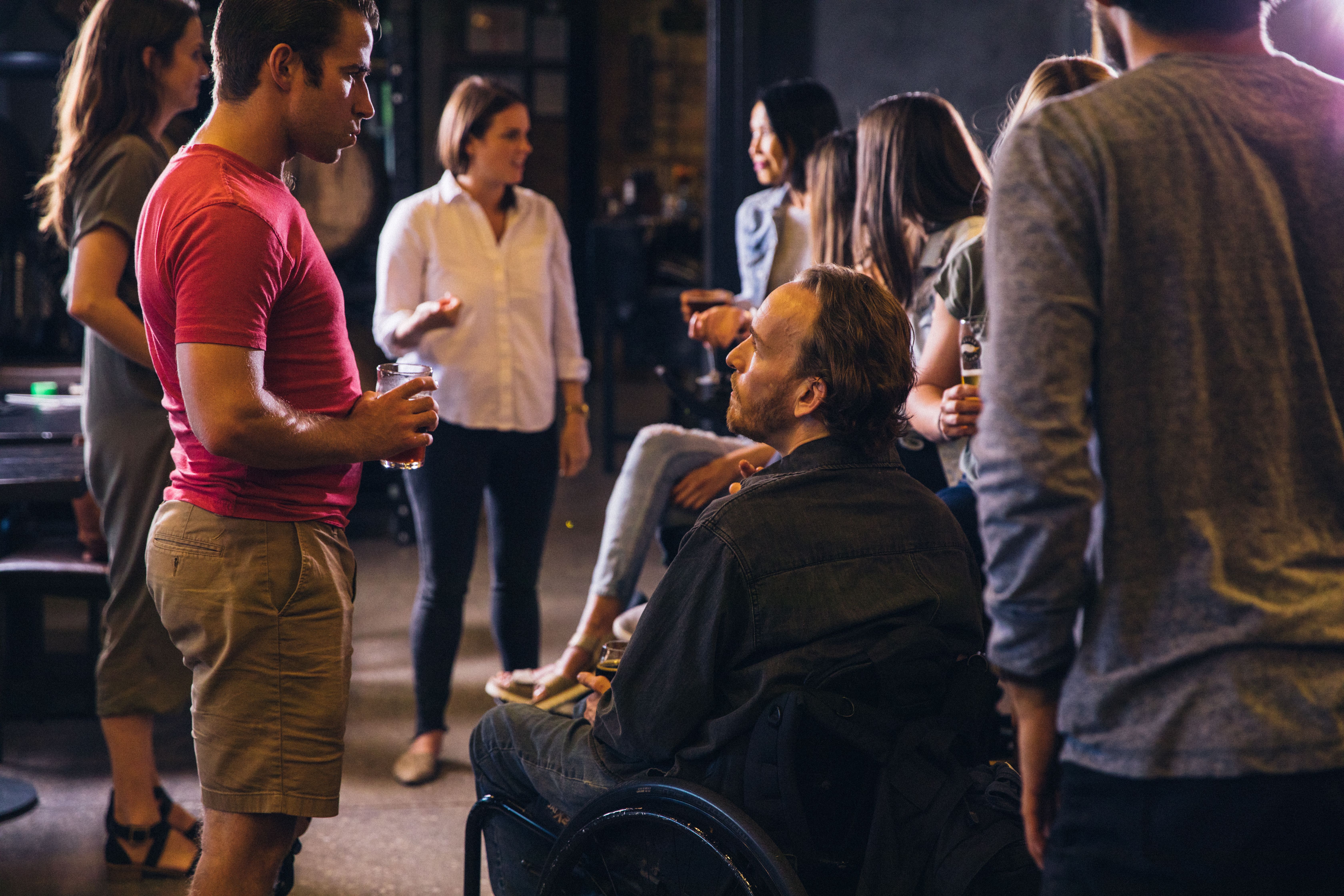
Barriers to social connection
Loneliness
Disabled people are more than four times as likely to be lonely as non-disabled people. If you’re disabled, you are more likely to feel socially isolated, and to feel like you don’t have the social support you need.
Loneliness can have a profound negative effect on your sense of personal wellbeing. It’s linked with feelings like anxiety and general life satisfaction. Disabled people tend to experience the effects of loneliness in the same way as non-disabled people, just more often (Emerson et al., 2021).
Pressure from society
It can feel daunting to put yourself out there, especially if you’ve had negative experiences in the past. You might worry that people will react badly to you or behave differently around you. You may feel that non-disabled people, or people who have a different condition or impairment to you, will not understand your experiences and won’t know how to include you in their social activities.
This is a perfectly valid worry to have. But if you worry too much about fitting in, you may decide it’s not worth the risk of showing up. And when you do show up, you might find yourself masking, where you act in a certain way or hide parts of your true self in an effort to fit in (Bacon et al., 2025).
Social perceptions
The way you are perceived by non-disabled people, or even the way you feel you are perceived, can be a blocker to making new friends. If you’ve noticed that others don’t accept you or that they make it hard for you to fit in, it can be very isolating. You may feel entirely excluded from certain social activities.
This can sometimes happen if the majority of your relationships come from within the disabled community. Lots of disabled people bond with each other through a shared experience and understanding. While that can be a positive way to maintain a vibrant social life, it can also create a sense of ‘otherness’. You might feel like you’re on the outside of wider society, or that you don’t belong in a more mixed friendship group (Bacon et al., 2025).
If you do feel alone, it can lead to further difficulties in the way you approach social situations. You may start to become anxious or self-conscious, which can lead to further withdrawal.
Families and service networks
Who are the influential people in your life? Even if you have a strong social group, there are often external groups like family and service networks who can influence the way you experience the world – both positively and negatively.
Families can be a wonderful source of support, facilitating autonomy in your life and encouraging you to build new relationships. But they can also put up barriers, particularly if they hold a lot of control over your social life. Some family members might feel they have a right to dictate how you socialise, or vet the people you want to spend time with (Bacon et al., 2025).
Service networks can perform similar functions in your life. They can be great for meeting and getting to know people, but having to plan your life around service provision can take away some of the spontaneity of making friends. If you’re reliant on external provision for forming connections it can mean having to wait before you see someone again.
How to build friendships
Being a disabled person can be time consuming. Managing your condition or impairment often involves time and resources that take you away from the other areas of your life, and this can lead to missed connections.
Connections can also get missed when friends make assumptions about you. If friends assume you won’t be able to participate in something, or won’t want to, they may just leave you off the invitation list when they get together. Similarly, you might get the invitation and have to turn it down. If this happens a lot, you may risk being left out of future invitations (Sweet et al., 2018).
The way you challenge this will depend on the type of person you are. Are you someone who likes to be invited and have a choice, or would you prefer not to get the message if something is happening that you’re unlikely to be able to participate in? Your friends may not always know whether or not to include you. Once you know your own preferences, you can ask them to consider your needs.
Sometimes setting up a group chat can help you stay in the loop. That way you’ll know when people are getting together and you can make a choice about what’s appropriate for you. You can even ask for adjustments that support your inclusion, or just arrange your own activities and take charge of inviting people.
Communicate your needs
In any relationship it’s important to communicate your needs. What are the things you seek when planning social activities? Accessible travel? Restaurants without stairs? Environments that aren’t too noisy? Your friends might not always have a clear sense of how important these things are to you. Having an honest conversation can help them to consider your needs and make adjustments when planning social time (Scope, 2025).
Take a risk
It isn’t always easy to maintain social connections, especially with all the additional barriers you face as a disabled person. Sometimes it’s worth taking a risk so that you can get a sense of what an activity is like, figure out what the challenges are, and learn what you might need next time. You may even learn that there is more support available than you expected.
Social groups are all about finding shared connections and looking out for each other. If your presence at a social event makes someone else uncomfortable, that’s a reflection of them, not you. When your friendship group can approach activities with everybody’s wants and needs in mind, they may all start to notice that it’s better for everyone.
Disability pride is a great time to remind yourself, and your friends, that you matter, that you’re allowed to take part in society, that you deserve your place in the world. Share your needs, find activities that work for you, and show up with your true, unique, wonderful self.
References
Bacon, A., Hyland, A., James, S., Martin, N., O'Brien, G., Premkumar, P., Takhar, S. and Wilkinson, P. (2025). Disability, loneliness and relationships: a thematic report.
Emerson, E., Fortune, N., Llewellyn, G., & Stancliffe, R. (2021). Loneliness, social support, social isolation and wellbeing among working age adults with and without disability: Cross-sectional study. Disability and health journal, 14(1), 100965.
Scope. (2025, October 10). Maintaining friendships. https://www.scope.org.uk/advice-and-support/being-included-going-out-with-friends - Making-new-friends-click
Sweet, D., Byng, R., Webber, M., Enki, D. G., Porter, I., Larsen, J., Huxley, P. & Pinfold, V. (2018). Personal well-being networks, social capital and severe mental illness: exploratory study. The British Journal of Psychiatry, 212(5), 308-317.